The Gold Standard Base
The Myriad BRACAnalysis® is the definitive, high-fidelity genetic test for hereditary breast and ovarian cancer. Myriad Genetics is the pioneer of this technology; for years, they held the patents on the BRCA1 and BRCA2 genes.
A $4,000 Myriad test isn't just a "blood draw"—it is a comprehensive genomic sequencing. It involves:
- Full Sequencing: Analyzing every "letter" of the BRCA1 and BRCA2 genes to find mutations.
- Large Rearrangement Testing (BART): Looking for massive chunks of missing or extra DNA that standard tests miss.
- The Baseline: This report creates the Permanent Genetic Record of a patient’s life. It is the raw data that stays the same from birth to death
Why the $4,000 Bill Matters (The Barrier to Entry)
In 2013, a $4,000 genetic test was a "high-walled garden." To get Blue Cross Blue Shield to approve that bill, a patient had to:
- Prove High Risk: Meet strict clinical criteria based on family history (The real pedigree).
- Survive the Audit: Pass a rigorous "Medical Necessity" review.
- The Investment: That $4,000 represents a massive investment by the insurance company and the patient into the truth.
The Mission: The Glenn Breast Center
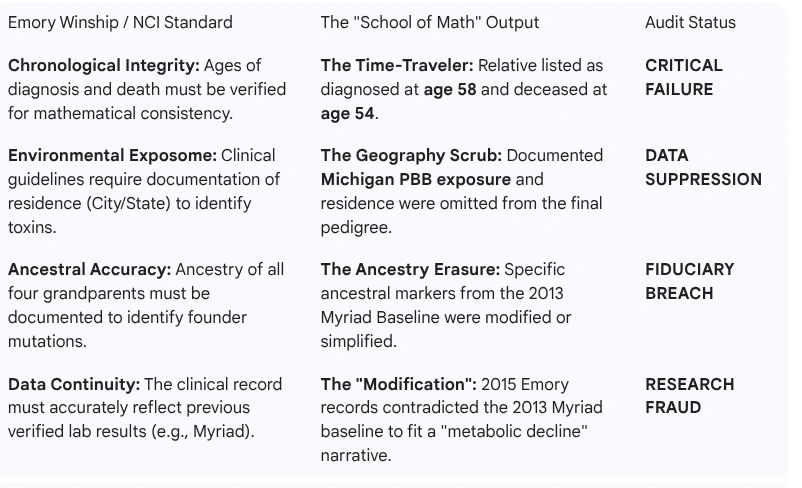
The stated mission of the Glenn Breast Center at Emory Winship Cancer Institute is to provide "individualized, comprehensive care" with a specific focus on "reducing the risk of breast cancer through genetic counseling and risk assessment." As a National Cancer Institute (NCI) designated center, they are federally funded to be the gold standard in data integrity. This website documents a total failure of that mission—where "individualized care" was replaced with data scrubbing, and "risk assessment" failed the most basic rules of arithmetic.
Why I’m Here (The Auditor's Note)
"I am a BRCA1-positive patient and a 2026 Ironman Foundation Ambassador. I am here because 'Precision Medicine' requires precision. When an institution receives millions in taxpayer-funded grants to study genetics but produces records stating a patient’s relative died four years before they were diagnosed, the public has a right to see the math. I am not just a patient; I am a data point that refused to be 'modified' to fit a grant narrative.
What is Genetic Counseling
Genetic counseling is the process of evaluating family health history and risk factors to provide a roadmap for life-saving medical decisions. In "Precision Medicine," this data—known as a pedigree—is the foundation of everything. It determines if you qualify for preventative surgeries, specialized screenings, or clinical trials. When a pedigree is accurate, it saves lives. When it is fabricated or mathematically impossible, the entire "Precision" model collapses, leaving the patient at risk and the research data fraudulent.
Definition: The Emory Winship Genetic Pedigree
According to the Winship Cancer Institute of Emory University and the Emory School of Medicine Genetic Counseling Program, a Genetic Pedigree is a standardized, three-generation diagnostic chart used to assess hereditary cancer risk.
Per Emory’s Clinical Standards, a valid pedigree MUST include:
- Vital Status & Chronology: Exact age for living relatives and Age at Death for deceased relatives.
- Audit Note: In the "Emory School of Math," the status of "Deceased" is apparently compatible with being diagnosed four years later.
- Ancestry & Origins: The specific Race, Ancestry, and Ethnicity of all four grandparents. This is critical for identifying "founder effects" in populations like the Michigan PBB cohort or Ashkenazi lineages.
- Geographic Residence: Documented residence (City, State) for family members to identify environmental risk factors.
- Ages of Onset: The specific age at which each relative was diagnosed with cancer. This data is the only way to calculate a patient's lifetime risk percentage.
- Lifestyle & Environment: Documentation of "lifestyle patterns" and exposures that may act as catalysts for genetic mutations.
Myriad vs. Emory
The 2013 Myriad Report cost $4,000 and documented my DNA with 99.9% accuracy. It included my ancestral markers and the baseline for my survival. Two years later, the Emory School of Math took this $4,000 baseline and 'modified' it into a pedigree where relatives die before they are diagnosed and Michigan PBB history vanishes. They didn't just fail a patient; they corrupted a $4,000 piece of medical evidence.
For a BRCA1-positive patient, "Michigan" isn't just a place on a map; it is a Clinical Risk Factor. *
The Science: PBB is an endocrine disruptor that mimics estrogen.
- The Synergy: When you combine a BRCA1 mutation with PBB exposure, you are looking at a "loaded gun" scenario for breast cancer.
- The Requirement: To provide "Precision Medicine," an institution must document environmental toxicants that act as catalysts for genetic mutations
The Missing Variable (Michigan PBB)
The 2017 "Comprehensive" Pivot: Why My Data Was Scrubbed
In 2017, Emory Winship was hunting for the "Gold Standard"—the NCI Comprehensive Cancer Center designation. This elite status brings in millions in federal funding, but it requires "clean" data sets that prove the institution is a leader in Precision Prevention.
The Problem with My Data:
I am BRCA1-positive, but I have never had cancer. In the world of clinical research, I am what is known as a "Previvor."
For an institution looking to prove its "Genetic Risk Assessment" prowess, I am a high-value data point.
The Scrub:By deleting "Michigan" and "PBB" from my 2015 Pedigree, Emory effectively de-linked my high-risk status from its environmental catalyst. *
The Research Incentive: It is much easier to secure "Precision Medicine" grants for a "pure" BRCA1 case than it is for a complex case involving PBB (Polybrominated Biphenyl)—a known endocrine disruptor from my childhood in Oak Park, Michigan.
- The Clinical Erasure: When they scrubbed my history of environmental exposure, they didn't just "simplify" a map. They erased the Exposome—the very thing their federally funded HERCULES Center is paid to study.
- The Math Error: To make me fit their "Genetic Research" narrative, they produced a pedigree where my relatives' diagnosis and death dates don't even obey the laws of time (58 vs. 54).
The Bottom Line:They didn't need to "cure" my cancer; they needed to curate my data. They traded the accuracy of my preventative care for a "Comprehensive" designation and the federal millions that come with it.
"There is no limit to what a man can do or where he can go if he does not mind who gets the credit."
Robert Woodruff
Copyright © 2026 The Impossible Pedigree - All Rights Reserved.
This website uses cookies.
We use cookies to analyze website traffic and optimize your website experience. By accepting our use of cookies, your data will be aggregated with all other user data.